 |
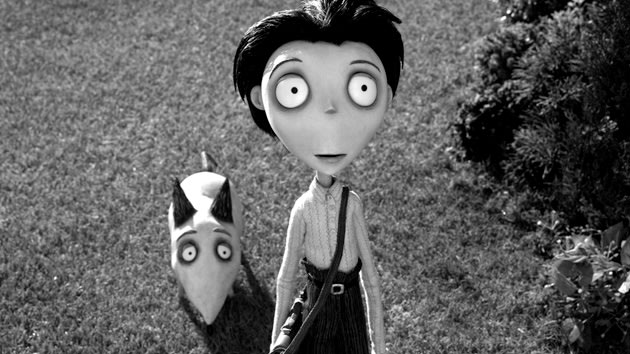
| Victor and Sparky in the 2011 Frankenweenie.
Tim Burton's Frankenweenie tells the tale of a young boy who loves his trusty dog, Sparky, so much that he literally can't bear to live without him. After Sparky is fatally wounded by a car accident, Victor decides to bring him back to life. The 1984 and 2012 versions of Frankenweenie share basic plot elements, but there are major differences between the two.
The most obvious difference between the films is Burton's use of animation in the 2012 version. I believe this technique makes it much more Burtonian, since it allows for more creative expression. The characters in the film look strikingly similar to previous drawings we've seen of Burton's. The wide-eyed girl with the cat in Frankenweenie is nearly identical to Burton's illustration of Staring Girl in The Melancholy Death of Oyster Boy & Other Stories. Overall, the freedom stop-motion allows give the movie an artistic flair that Burton fans are accustomed to. Since the people aren't actually real, the characters' figures and expressions can be extremely exaggerated. The 1984 version is more relateable because of the live cast, but the 2012 version reaches a higher level of poignancy than the older one for me. This could also be due to another big difference between the two films. The 2012 version is much longer and has a more detailed story line than the prior. Being only about half an hour, the 1984 version did not develop the story as extensively as the stop-motion. The science fair and resentful kids at Victor's school is not included at all in the 1984 version, making Victor's outsider-ness seem less prominent. His feelings of loss and loneliness affected me more deeply when the 2011 movie included emotionally charged scenes.
The stop motion characteristic of the 2012 version also seems to match the overall story much better. I say this mainly because of the gothical fantasy feel this film has. Live people bringing a dog back to life could obviously not happen in the real world, so it is much more convincing when animated. Additionally, it just makes the film seem spookier and definitely more Burtonian. There are multiple scenes that are basically identical in both versions, but to me they are better suited in for 2012 film. For example, whenever the dog's neck bolt's would spark, it just looked a little silly. He is brought back to life for the final time in the 1984 version, but the scene lacked seriousness because the sparks emitting from him looked unnatural and a little absurd. The fantastical aspects of Frankenweenie are better executed in the the newer version.
Both films convey the importance of life and death, but I personally preferred the stop-motion version. I think it better the suited the plotline and brought to life the unique characters in the film. Tim Burton's aesthetic flair really added to the morbid attitude the movie is centered around as well. The concept of death was approached in an offbeat and entertaining fashion, but the serious undertone is still present. Burton's strength in the art of stop-motion brings this story to life.
|
Sunday, April 28, 2013
McCurdy- Frankenweenie

Friday, April 19, 2013
McCurdy- Sweeney Todd
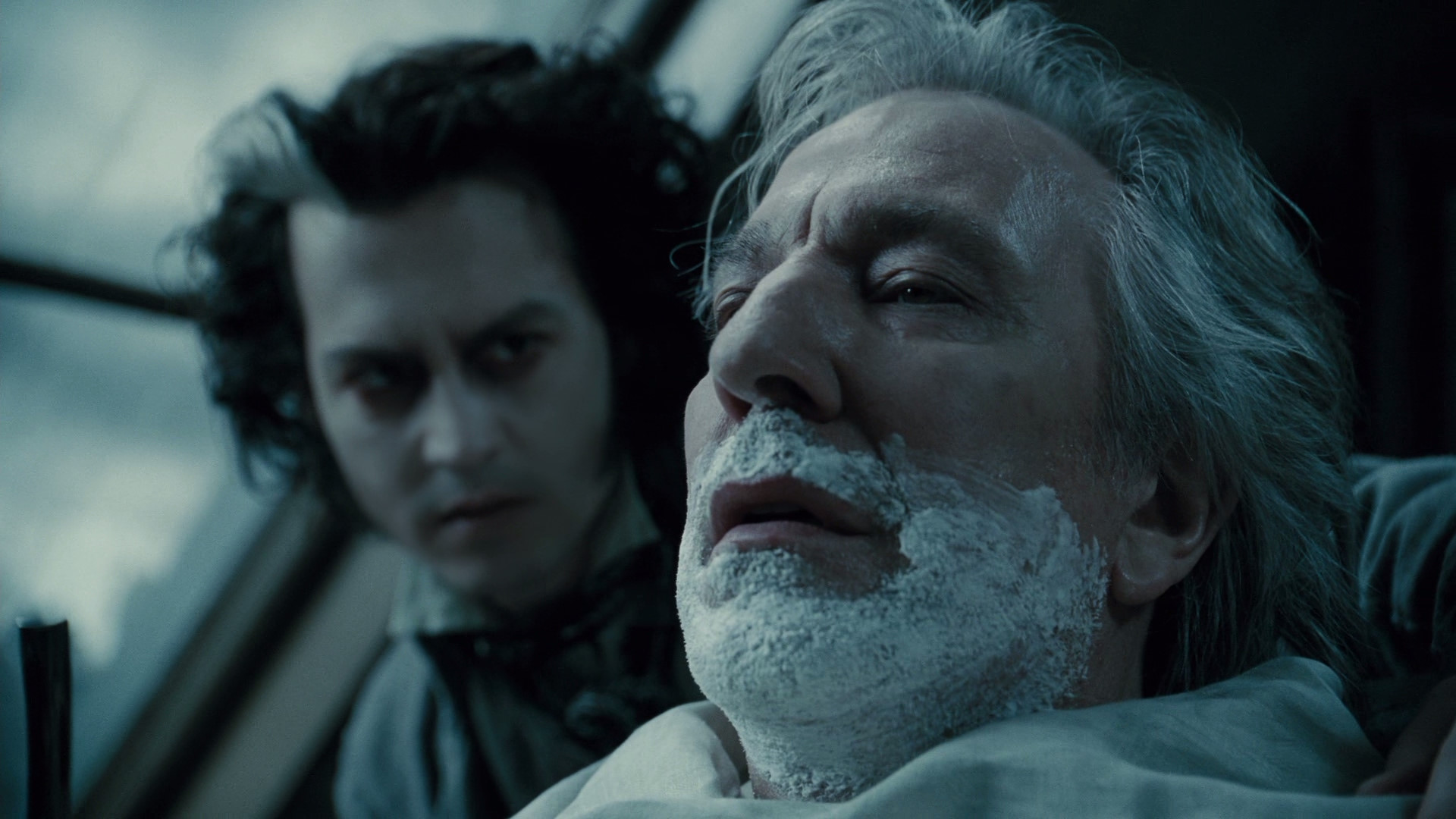 |
| Judge Turpin and Sweeney Todd |
Tim Burton illustrates the story in such a way that cannibalism doesn't seem so wrong. Victims being killed and baked into pies initially sounds macabre, but the audience becomes sympathetic to Sweeney due to his situation. He is trying to cope with the loss of the most important people in his life: his wife and Johanna. People need outlets for inner tensions, and Sweeney finds his in a very brutal form. The film does not hold back from showing the gruesomeness Sweeney Todd used on his victims.
Sweeney Todd makes sense of cannibalism and does not make it seem like the horrible crime it is. In a way, it shows the lengths people would go to in order to survive. Urbanization was starting in London and Sweeney Todd portrays the unbelievable things people would take part in so they could be successful.Mrs. Lovett came up with the idea of baking people into pies as a result of her twisted morals and failing business. She realized if she didn't have to pay for the main ingredient (meat), her business would begin to boom. London was growing and she needed to keep up. People would go to great extents such as this so they could have a thriving career and not fall behind as the city urbanized and grew.
The film has a twisted theme, but Tim Burton and Sweeney make it seem justifiable. Sweeney takes on a new persona that brings his inner desires to the surface, just as many others wish they could do at times. The story may come off as grotesque at first, but the characters convey the importance of what they're doing and earn sympathy from the audience.
Thursday, April 11, 2013
McCurdy- Big Fish
 |
| Edward Bloom in Big Fish Edward Bloom meets very interesting characters as he goes through life, but they do not necessarily have the same positive outlook on life as he. He generally has a very sunny disposition throughout Big Fish, and he tries to spread this to others when interacting with them. He is happy and wants everyone else to be. However, many of the people he meets are very different from him. Interestingly enough though, the grotesque characters he encounters are drawn to him, and vice versa. They seem to find joy in being with each other, regardless of their differences. For example, when Edward meets the people of Spectre, they try to force him to stay in their idealistic, cookie-cutter society. He treats them with kindness, even though he realizes their differences. Even when he decides to leave the town, he remains on good terms with them and does not reject them because of contrasting opinions. They feel the same way toward him as well, because they respect his sunny personality and respectful tone. The giant Edward meets would generally scare people, but he is drawn to him and understands that he is a genuinely sweet person on the inside. The giant and Edward both trust each other, putting their differences aside. The giant believes Edward will stray from him when they are journeying together, but Edward assures him that he won't and gives him his backpack as a symbol of trust. They have mutual respect for each other and accept them for who they are. Making these connections between contrasting personalities is very important to Tim Burton, seeing as he has been doing it his entire life. Burton went through life meeting various people he was drawn to and created somewhat of a family out of them. He realizes that just because people have differences does not mean they can't get along. In fact, varying personalities can often come together and create a beautiful friendship. This is highlighted in Big Fish, especially when it comes to Edward Bloom's relationships with others. They both accept themselves for who they really are. |
Wednesday, April 3, 2013
McCurdy- Sleepy Hollow
 |
| Johnny Depp in Sleepy Hollow.
In comparison to Washington Irving's original story, Burton's film adaptation is very different. The entire narrative is transformed, and it basically is a new story. However, Burton noted that it was important to him to keep the atmosphere of the story the same as well as the historic character names. Both of those things gave a certain feel to the story that he did not want taken away. Regardless, the plot is completely different and Burton adds many more elements that definitely make it more appealing to Hollywood audiences.
An important element he creates is Ichabod Crane's parental backstory. The audience learns that his mother died when he was a young child and his father was a stern religious man. Because of this, the audience develops a sense of poignancy toward the character and can relate to his early struggles. It also explains his dependency on science and reason. In Washington Irving's story, his parents were not even mentioned and he did not have trouble straying away from the ideals of scientific thought. The flashbacks in Burton's film help the audience understand why Ichabod has become the man he is.
Also in Burton's version, Ichabod does not suddenly disappear at the end. Instead, he saves the day by returning the skull to the Headless Horseman. Additionally, he continues falling in love with Katrina, which was not expanded on in the original story. The ending resolution and addition of romance makes the story more likeable to audiences, since people generally enjoy happy endings and evil being defeated.
Another contrast between the two stories is the addition of Ichabod Crane's accomplice, the young boy. Since his parents have died, he asks Crane if he can join in figuring out the mystery of the Headless Horseman. He helps him along the way and adds to the plot.
Burton's version enhances the story in a way, but really it is completely different so it's hard to compare which one is "better." He uses the original legend in the story, the character names, and the familiar atmosphere, but the entire narrative has been changed. He does much more with Irving's story, making it very different from the original Sleepy Hollow.
|
Friday, March 22, 2013
McCurdy- Planet of the Apes
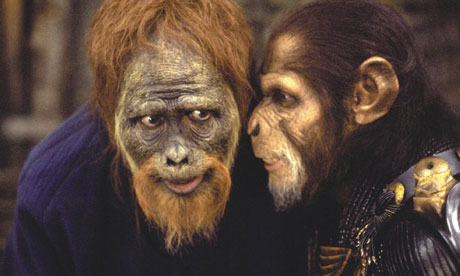 |
| Planet of the Apes |
Mark Wahlberg came to the new land in a spacecraft, but when he finally reaches the wrecked ship again, the apes do not know what to think. They have never seen such a thing before, since they rely on simple horses to transport them around. They are also disturbed when Wahlberg's character pulls out firearms. They are afraid of the deadly weapon and destroy it as to not allow him the upperhand against all of the apes in the territory. The apes are generally very weary of all technology Davidson presents, since they have never seen such things before. They rely on the land and natural resources and have not advanced into such a state of technological advance and industrialism. Their mindsets are also not as open as the humans. In many ways, they are timid. For example, Ari is terrified of water and just the sight of it makes her scream.
Even more scientific bounds are displayed to the apes when Davidson finds his crewmates' wrecked ship with limited video footage of what had occurred before the plane crash. The apes don't have such technology and were astounded. However, Davidson too was shocked, but for different reasons. The apes told him that the ship had been wrecked for thousands of years, but he remembers the crash as if it were just three days ago.
Primitivism and science are repeatedly conflicting in this film, but together they create a duality. It is similar to the duality created by the species of both humans and apes existing together in this story.
Wednesday, March 13, 2013
McCurdy- Mars Attacks!
 |
| Aliens from Mars Attacks!
Mars Attacks! parodies America in general, but especially satirizes sacred institutions, such as the military and government. The government is basically helpless when he aliens invade. This is very comical, but it also illustrates that we should not always be so entrusting of our own government that is said to always be protecting us. Every individual should also be able to take care of themselves. This is also true for the military in the movie. The aliens immediately terminate them without hesitance. Their armaments easily overpower that of the American soldiers.
A scene that displays the corruption of government is when Martin Short's character picks up a woman from the street, who turns out to be a martian girl that wreaks havoc in the White House. He picked up the girl for his own personal gain, but she ended up killing the president. Burton is showing that people cannot always trust the officials of sacred institutions. They may just end up failing at their job... or suddenly getting zapped by alien intruders.
Also, the military is proved untrustworthy when the aliens first depart from their space shuttle. The entire military is waiting outside in preparation for them. They release a dove as a sign of peace, but the aliens shoot it down immediately. Then, chaos erupts and the aliens continue to shoot at all of soldiers surrounding them. They even kill the head of the military who represented protection for the people. Just like the government, the military in this movie cannot be held in high regards. Even though they are supposed to protect the people against the alien attacks, they are miserably failing. People have to take care of themselves.
Interestingly enough, the people who don't rely on these institutions for guidance end up surviving. Two examples of this are Taffy and Richie. Taffy consistently rolls her eyes at her presidential father's decisions and Richie ignores what his trailer-park parents say altogether. They both disregard the chaos people are partaking in and focus on what is good for them. The fact that Tim Burton allows these people to survive shows that he too scoffs at "sacred" institutions.
|
Tuesday, March 5, 2013
McCurdy Ed Wood
 |
| Johnny Depp as Ed Wood.
It is obvious after viewing Ed Wood that Tim Burton can easily connect with this so called "worst director of all time." They have many things in common and that seems to be why Burton was moved to make this film in the first place. Though Wood was notorious for creating this awful flicks, Burton was drawn moreso to the reasons behind the film making. In Burton's biopic, Ed Wood Finally receives some deserved credit as a director. He pays homage to him in a way, allowing Wood to be redeemed to much of the ignorant public eye.
One way in which he credits Wood's film making is illustrating Ed's drive to create films that he thought would be great, not out of arrogance or for the money. Time after time in Burton's film, Ed Wood can be seen passionately involved with the his own film process, mouthing script lines as actors are reciting them and enthusiastically exclaiming that the scene was perfect after just one shot. Wood also created a group of actors that appeared in his films who were originally outcasts. Though this individuals may not be the greatest of actors, they stuck together through every film with him and continued on no matter the poor reputation or lack of money. They were bound together by their outsider qualities and Ed Wood believed in them when no one else did. In particular, the public believed Bela Lugosi to be past his prime, but Wood recognized his talent and thought he deserved recognition on screen. Finally, Ed Wood went to great lengths to raise funds for his films, even when times got rough (which was... most of the time). He believed in his movies for what they were and wanted to get them produced and out to audiences. Many directors do not have the patience and drive to raise funds for their films time after time, especially when people remark on how awful they turn out to be.
Burton uses scenes from Ed Wood's films in his own to continue paying his homage. The inclusion of these scenes also gives the audience a better feel for what Wood was creating and gives more insight to what emotion and creativity he was trying to display in them. Ed Wood's directing style was misunderstood at the time, but Burton appreciates his honest drive and in many ways redeems him as a director through this film.
|
Thursday, February 21, 2013
McCurdy- Anchor Baby by Tim Burton
 |
| Photo from Anchor Baby by Tim Burton. |
Anchor Baby centers around a woman who lives under the sea but is pining for a man above ground. She wants to find a way to stabilize her relationship with him and decides a baby is the best way to do so. However, the anchor baby ends up burdening their relationship and sinking her to the bottom of the ocean once again. The fact that she is abandoned by her lover parallels with Burton's feelings of abandonment he felt as a child. He did not connect with his parents of the kids around him and often felt very alone. Since she spends her life in the sea, she is also an outsider, just as Burton was. She can try as hard as possible to be like her lover on land, but their differences will never allow their relationship to work out. This takes a toll on the anchor baby's life as well. His mother basically rejects him since he tore her away from her lover, thus he feels abandoned by her. They are both suffering from a loss of contact, but in different ways. Burton suffered from his suburbial life when he came in contact with no one similar to him. Luckily, Burton is in the real world and has a creative outlet through art and film, but the sea woman is stuck in a story underwater.
This story puts a twist on the Great Mother archetype, since the woman who so longed to be a mother ended up being a terrible one due to the depressing circumstances. The poor anchor baby ends up feeling abandoned and alone. Even though he was created to stabilize her life, he ends up burdening it and they end up both at a loss. Traditionally, the Great Mother is nurturing and kind, but she shys away from her baby.
Wednesday, February 13, 2013
McCurdy Carnival/Mardi Gras
 |
| Craziness in the French Quarter during Mardi Gras.
Carnival is a festive time of year that occurs right before Lent. It is a time when everyone can let loose and have fun before it is time to buckle down and "live a modest lifestyle" after Fat Tuesday. In New Orleans, carnival takes its place in the form of Mardi Gras. As a freshmen here at Loyola, I had never experienced Mardi Gras before. After this week's festivities, it is safe to say that I can't wait until Mardi Gras comes around again next year. New Orleans has so much pride as a city itself and it is expressed even more so during the parades. I attended quite a few and they got crazier each time. The main problem I face now is where to stash all the beads I acquired over the past week. My favorite catch prizes I got from the floats are a stuffed pig, a Saints mini football, a stack of cups, and the official Krewe d'Etat bead. I was rather disappointed that I didn't get a shoe from Muses, but there's always next year! I learned that you have the most fun and gather the most throws if you're right next to the float on the parade route. You almost must be prepared to do some serious walking if you don't want to pay a fortune to get to a parade. There's no telling how many miles I walked from school for Mardi Gras, but it was well worth it. Mardi Gras is definitely an experience you have to live to understand. It actually lives up to all it's wonderful expectations though.
Tim Burton's films takes elements from the idea of carnival and twists them into his own movie molds. Many of the characters like Beetlejuice, Penguin, and Edward Scissorhands are all costumed creatures that could easily be paralleled to people participating of the carnival. The Joker may be the strongest supporter of this notion, considering his trickster antics, vivid costumes, and colorful contraptions.The crazy costumed villains in Burton's films also display the idea of underlying chaos in the carnival. Though they seem colorful and fun on the outside, they actually have evil motives and are duping society majority of the time.
|
Friday, February 8, 2013
McCurdy Edward Scissorhands
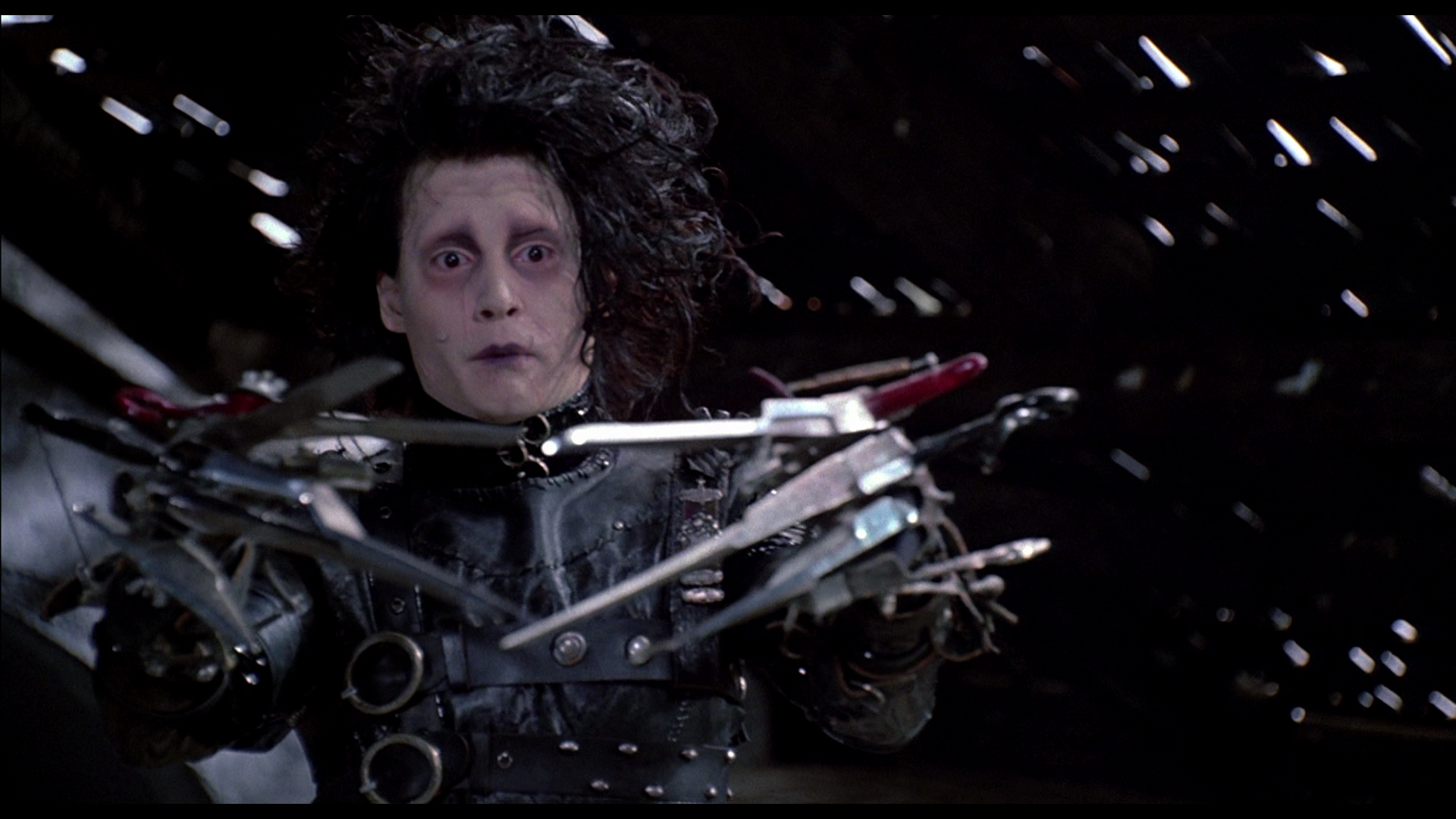 |
| Johnny Depp as Edward Scissorhands.
Edward Scissorhands contains many elements of a fairytale, but in no way does it end "happily" like most children's tales do. The people of the town are immoral and Edward is quite the opposite, even though he has much to learn. He is a benevolent creature among the harsh, cookie-cutter people that inhabit the town. Even though Edward is the one with weapons for hands, the people around him are more caustic and evil than he could ever be. The acts of violence he commits are all accidental and without harm. However, once the townspeople turn against him, they do not shy away from terrorizing him. They will do anything to run him out of town and regress back to their normal drab lives. Kim's boyfriend Jim, in particular, is openly violent toward Edward and is one of the most ethically twisted characters in the film. Everything he does is for himself. He uses Edward just to get what he wants and turns on him when Kim falls for Edward instead.
Unlike traditional fairytales, the violence in the film doesn't lead to Jim or the townspeople learning a lesson. Instead, Edward is isolated even more and thus has no happy ending. He is torn away from Kim, his "princess," solely because of society. The town isn't as picturesque and squeaky clean as it initially appears. The colorful pink, blue, yellow, and green homes are actually just housing the harsh townspeople. Generally, we associate vivid colors with positivity, but it is just the opposite in the film. Oddly enough, the character who possesses the most kindness is dressed in all black.
Edward is a victim and the unmoralistic citizens take advantage of him. At first, they find him new and exciting. With his talents, they use him to create topiaries in their yards and do their hair. However, the second he doesn't abide by their rules anymore, they reject him. They are too immature to deal with real change and people that differ from them. The film encompasses the twisted morals of modern society with a twist on the ordinary fairytale.
|
Wednesday, January 30, 2013
McCurdy Batman Returns
Prompt #2 for Batman Returns
 |
| Catwoman played by Michelle Pfeiffer.
Batman and Catwoman have a very complex relationship, especially considering that they both have alternate identities. They meet each other at a very pivotal point in Selina's life, which makes it even harder for them to be together since she has recently been turned against men. She's hurt and trying to mold herself into the independent woman she wants to become, but is still occasionally struggling with who she actually is. But either way, she is a much more mysterious woman to Bruce than Vicki Vale ever was.
As Selina, Bruce Wayne finds her very attractive from the first moment they speak in Max Schreck's office. This is immediately following her transformation and her confidence is oozing to all that come in contact with her. You can tell Bruce is intrigued by her and her new found sexuality. Upon seeing her the second time when they run into each other on the street, they find out they have more in common than they thought. They scoff at the tree lighting that is set to occur later that night, discovering that they both find many things in Gotham City quite absurd and overrated. As their conversation progresses, Bruce suggests to Selina that she has kind of a dark side. "No darker than yours, Bruce," she responds. Little do they know how true that statement really is. On their first date at Bruce's house, his attraction grows even more, especially with her overt sexuality on the couch.
Things grow more complex when a news report flashes on the TV about a kidnapping in the city. They make excuses to leave, but they are both unaware that they're actually going to the same place. When they arrive at the scene as Batman and Catwoman, they end up fighting each other. This is only one of the many instances when they run into each other and are suddenly enemies. As Catwoman, she is destructive to Batman. She is continually trying to overbear him both mentally and physically. Her instincts to take down any man kicks in every time and she hates to see him as a strong figure of power and heroism.
When they finally discover each other's alternate identities, Selina chooses her independence over him. She denies him as both Bruce Wayne and Batman. Though they might be "the same" in terms of dual natures, their constant battle between lover and enemy outweighs this and makes their relationship too complex to sustain.
|
Thursday, January 24, 2013
McCurdy Batman
 |
| Batman at the end of the film, looking upon Gotham City.
Whether it was intentional or not, Tim Buton's Batman shares many elements with the film noir genre. The movie overall does a successful job of creating a very dark and gloomy atmosphere that is so iconic in films of this type. Rarely do we see very much daylight in the film at all and even when there are small portions of it, shadows still linger and provide an eerie feel. There is a sharp contrast between light and dark in the film, which also illustrates the dualing good and evil of Batman and the Joker. Gotham City is extremely isolated and therefore caters to the theme of alienation that both Batman and the city itself can relate to. Corruption lingers within the city, even if it is not visible on the surface. From the beginning, the viewers can tell that something is looming past these dark streets and buildings of Gotham City... perhaps something that is there to cause harm. Burton makes it clear that there is something off-balance in this cryptic place.
In addition to the surroundings, Batman also contains two prominent protagonists that are clearly very conflicted within. The Joker and Batman both have serious mental struggles that they can't seem to overcome and pose an important role in what they are doing today. For most, it's not exactly commonplace to be the maniacal instigator of crime or the hero of the hour, but for them, evidently it's the ever day norm. Their psyche is obviously flawed, and this is a key element for the "conflicted hero" of film noir.
Opposite our conflicted man in black is Vicki Vale-- the quick-witted and glamorous woman behind a camera who steals the heart of Bruce Wayne. In this case, she also seems to fill the role of femme fatale. As a capable and independent woman, she seduces Bruce in such a way that he just can't turn away. Perhaps it's dangerous that she is such a distraction in his life, but that reflects the stronghold she has on him as a femme fatale. Whether he is Batman or Bruce, he always saves her from peril.
With the compilation of all these dark elements and particular characters, Tim Burton creates a kind of film that distinguishes itself as film noir.
|
Thursday, January 17, 2013
McCurdy Beetlejuice
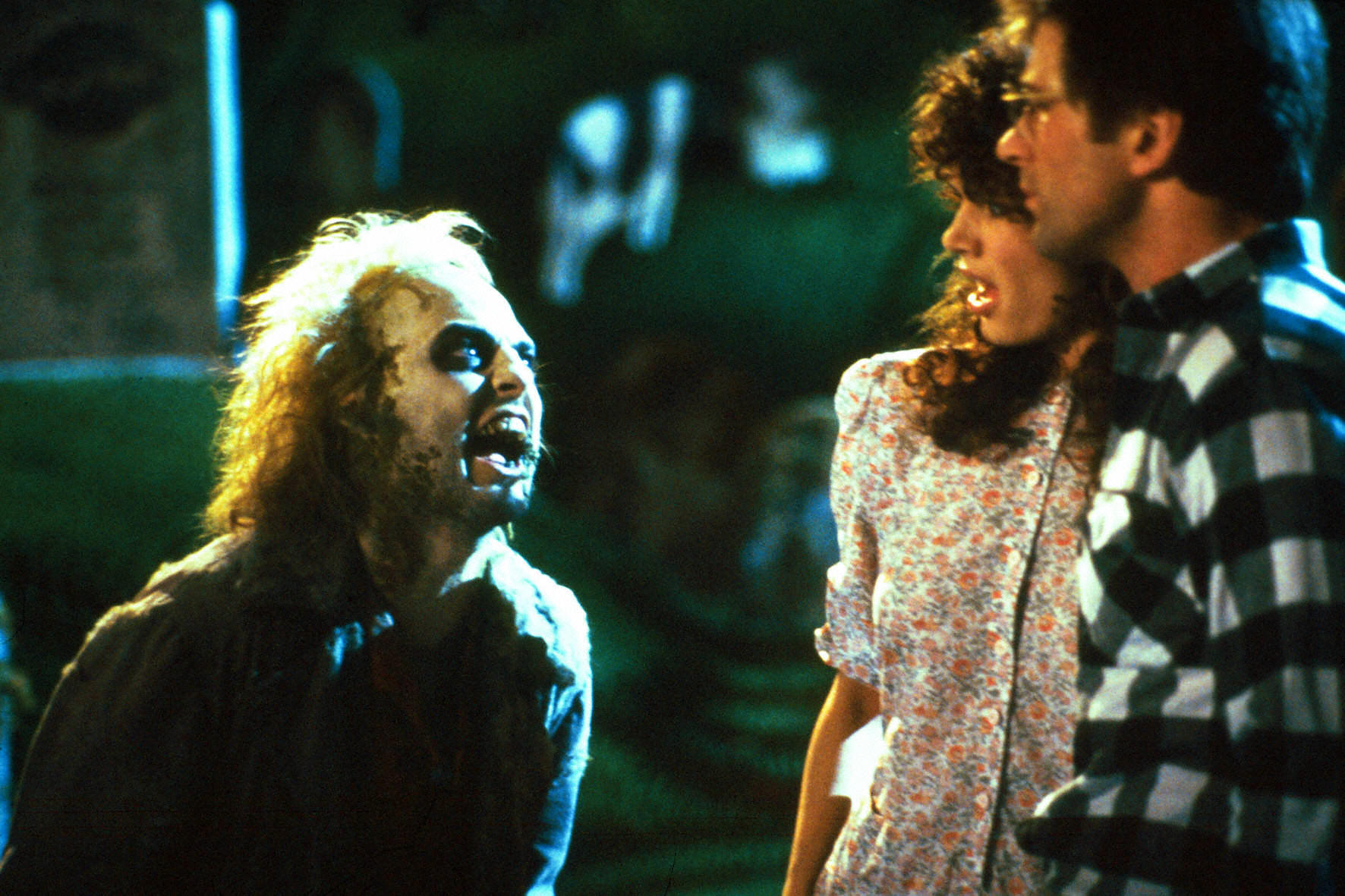 |
| Beetlejuice attempting to convince the Maitlands that he can successfully rid their home of the Deetz family. As much of a fascination Americans have with carnage and excessive gore, one would think that death could be openly discussed in this nation. However, as a general rule, most Americans will do anything to avoid the topic of death, especially when it involves coping with someone very close that has recently passed. Death is by no means a topic that should be handled lightly, but it's also important to face the tragedy when it does occur. Americans want to deny death for many reasons, depending on the individual-- usually, though, it's hardest for us to accept the realization that the person is actually gone... forever. The mother who raised us, your best friend around the corner, your hairdresser of 14 years; it's not easy to imagine these crucial parts of our lives suddenly disappearing. It's scary to think that death could hit someone at any moment as well. Perhaps denying death altogether makes it easier for humans to get through the day-to-day routine. Clearly, no one wants to be living in fear-- and if you abolish the thought of it altogether, what's there to actually be frightened of? Furthermore, if death hits you personally, what's the point of everything you've accomplished or are currently working toward? With a morbid perspective, suddenly all these expensive linens, fine-tuned technological gadgets, and $200 sunglasses seem worthless. Our life needs worth and these things provide us with fleeting satisfaction. Instead of accepting death, people find ways of denying or comforting the idea of it. In many cases, that's why people rely on a heaven or afterlife. In the film Beetlejuice, death is certainly denied, especially in that it is depicted as seemingly just another chapter of life. Immediately following the Maitlands demise, they return to their home with everything as it was before-- in fact, they don't even realize that they're actually dead. They continue to "live their lives," but now with some strange obstacles that most would not generally find themselves a part of. Also, though the Maitlands are technically invisible ghosts, Burton uses a clever plot tool to subtly deny death in the film: the Deetz parents and everyone else besides Lydia cannot actually see the death that surrounds them throughout the entire movie, the Maitlands. They are used to avoiding death even if it's staring them straight in the face, just as Americans do in this very country with whatever personal coping mechanism they are attuned to. |
Subscribe to:
Comments (Atom)